Regulatory action on greenwashing is no longer a future risk. In 2025 and 2026, enforcers in Australia, the UK, the EU, and North America have moved from guidance to live proceedings — using consumer protection law, financial services regulation, and new green-claims regimes to challenge claims that cannot be properly substantiated.
The practical implication is that sustainability claims now carry legal exposure across a wide range of channels: advertising, product labelling, sustainability reports, investor presentations, net-zero statements, and procurement documentation. Getting this right is a compliance requirement, not just a reputational consideration.
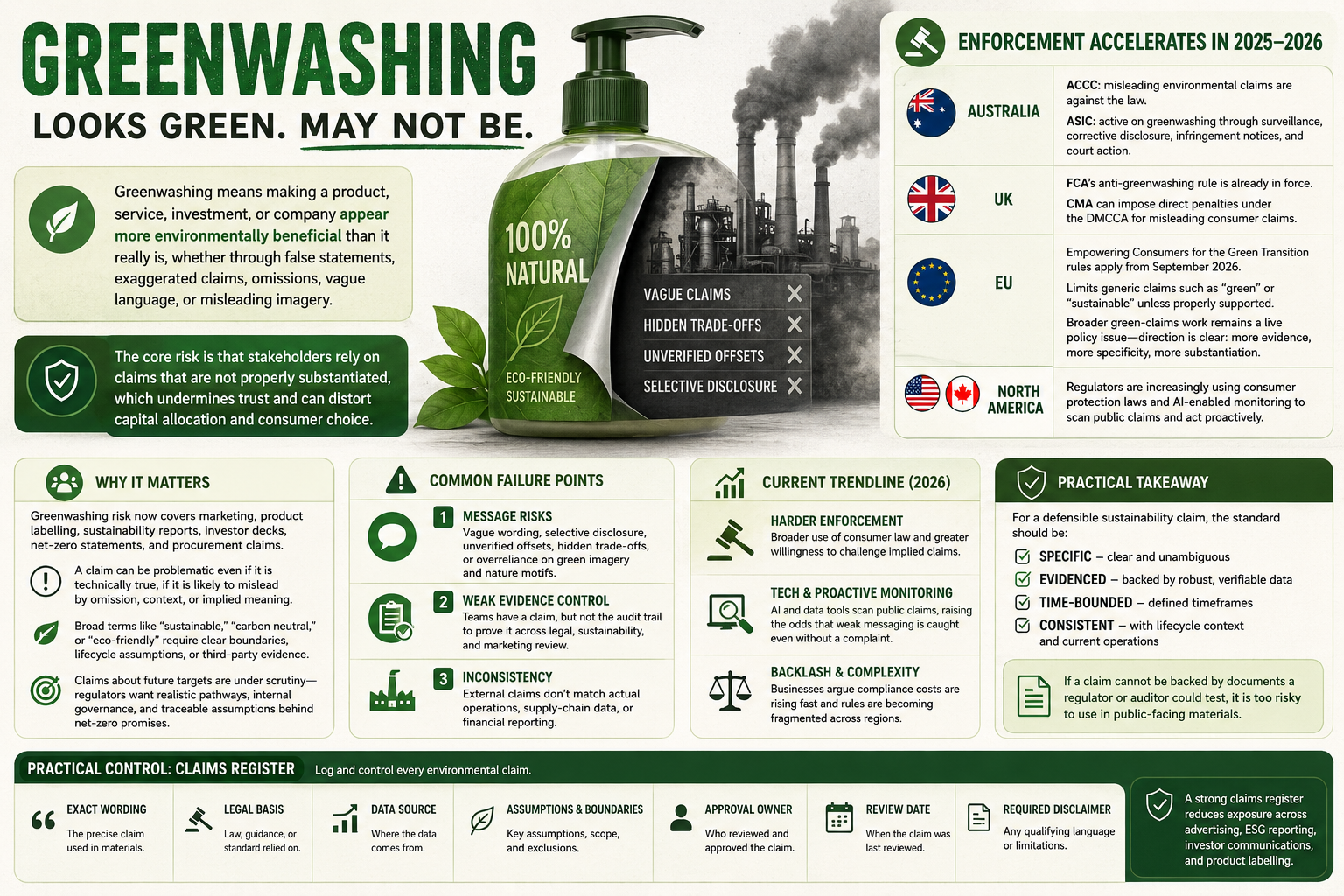
What greenwashing means
Greenwashing means making a product, service, investment, or company appear more environmentally beneficial than it really is — whether through false statements, exaggerated claims, omissions, vague language, or misleading imagery.
The core risk is that stakeholders rely on claims that are not properly substantiated. That undermines trust, distorts capital allocation toward products and companies that do not deliver the environmental outcomes they imply, and misleads consumers who are making purchasing decisions based on environmental credentials.
A claim can constitute greenwashing even if it is technically true. If it is likely to mislead by omission, context, or implied meaning — for example, by highlighting one environmental benefit while concealing a significant trade-off — it can still be unlawful under consumer protection law in most jurisdictions.
Greenwashing is not limited to outright false statements. Regulators are increasingly focused on implied claims, selective disclosure, and the overall impression that communications create — including through visual design, imagery, and branding cues that suggest environmental performance without making an explicit claim.
Why it matters now
Greenwashing risk now covers a broader set of communications than most organisations appreciate. The following types of claims can all fall within the scope of greenwashing scrutiny:
- Marketing and advertising: Product claims, campaign messaging, website statements, social media posts
- Product labelling: Packaging claims, certifications, origin or composition statements
- Sustainability reports: Annual disclosures, ESG reporting, TCFD-aligned climate statements
- Investor communications: Prospectuses, investor decks, fund-level ESG disclosures
- Net-zero and target statements: Commitments to carbon neutrality, net-zero by a stated year, emissions reduction targets
- Procurement claims: Supplier sustainability representations, tender responses, supply chain disclosures
The issue is especially acute where companies rely on broad terms like "sustainable," "carbon neutral," or "eco-friendly" without specifying the scope, the methodology, the boundary, or the evidence behind the claim. These terms are commonly understood to signal meaningful environmental performance — but they are often applied without the rigour to support that reading.
Claims about future targets are also under active scrutiny. Regulators want to see realistic pathways, internal governance, and traceable assumptions behind net-zero promises — not aspirational statements unsupported by current operational plans or credible transition strategies.
The enforcement landscape in 2025–2026
| Jurisdiction | Regulator / Instrument | Status & Approach |
|---|---|---|
| Australia | ACCC — Australian Consumer Law | ACCC has confirmed that misleading environmental claims contravene the ACL. Active enforcement via court action, infringement notices, and compliance programs targeting specific sectors. |
| Australia | ASIC — financial product greenwashing | ASIC has used surveillance, corrective disclosure requirements, infringement notices, and court proceedings against financial products and sustainability-linked disclosures that overstate environmental credentials. |
| UK | FCA — anti-greenwashing rule | The FCA's anti-greenwashing rule is already in force, requiring that sustainability references in financial promotions are fair, clear, and not misleading. Applies to all FCA-authorised firms. |
| UK | CMA — DMCCA direct penalties | The CMA can now impose direct financial penalties under the Digital Markets, Competition and Consumers Act for misleading consumer claims, without needing to seek a court order first. |
| EU | Empowering Consumers Directive | Applies from September 2026. Restricts generic environmental claims — "green," "sustainable," "eco-friendly" — unless backed by verifiable, recognised evidence. Bans vague sustainability labels without substantiation. |
| EU | Green Claims Directive | Broader proposed regime requiring pre-approval of environmental claims is still moving through the legislative process. Direction of travel is toward more specificity, more substantiation, and third-party verification. |
| North America | FTC — Green Guides (US) | FTC Green Guides are under review and enforcement has continued. State-level actions (particularly California) are also active, with some of the most aggressive standards for "carbon neutral" and related claims. |
The common thread across jurisdictions is a move from general guidance toward hard enforcement. Regulators are not waiting for complaints — several are running proactive surveillance programs to scan public claims, including digital monitoring of websites and advertising.
The EU's direction of travel is clearly toward more evidence, more specificity, and more substantiation. The September 2026 deadline for the Empowering Consumers rules means organisations with EU exposure need to have reviewed their claims vocabulary well before that date.
Common failure points
Vague and unqualified language
The most common single failure is using broad terms — "sustainable," "green," "environmentally friendly," "carbon neutral," "net zero" — without defining scope, methodology, or boundary. These terms carry strong implied meanings in consumer and investor contexts, and regulators are increasingly treating them as implied claims subject to the same substantiation requirements as explicit ones.
A claim of "carbon neutral" that covers only Scope 1 emissions, relies entirely on unverified offsets, or excludes significant Scope 3 categories is misleading in the overall impression it creates — regardless of whether the narrow technical claim could be defended.
Selective disclosure
Highlighting one environmental benefit while omitting a significant trade-off is a recognised form of greenwashing — sometimes called "hidden trade-off." A product marketed as using recycled content, for example, may still have a significantly higher carbon footprint than alternatives due to processing emissions. Omitting that context can make the overall claim misleading.
Selective disclosure also appears in sustainability reports: disclosing emissions reductions in Scope 1 while Scope 3 grows, or reporting against an intensity metric that improves while absolute emissions increase.
Unverified offsets
Claims of "carbon neutrality" that rely on offset credits face particularly close scrutiny. The quality of offset programs varies significantly, and the scientific validity of some credit types has been publicly challenged. Using low-quality or unverified offsets to underpin a "carbon neutral" claim — without disclosing the offset type, registry, vintage, or methodology — is a significant greenwashing exposure.
A "carbon neutral" claim supported by retired offsets is defensible in principle — but only if the underlying credits are from a credible standard, the retirement is verifiable on a public registry, the scope boundaries are clearly stated, and the claim does not imply whole-of-lifecycle neutrality when it only covers a subset of emissions.
Weak evidence control
A second major failure mode is the evidence gap: teams often have a claim, but not the audit trail to prove it. Marketing approves messaging based on a sustainability team summary; the underlying data, assumptions, and methodology are never formally documented; the claim drifts through design, translation, and regional adaptation without being re-checked.
This matters because the legal standard in most jurisdictions requires that the substantiation for a claim exist at the time the claim is made — not reconstructed later. An inability to produce contemporaneous evidence is itself a compliance failure.
Inconsistency across channels
A third failure is inconsistency between external claims and actual operations, supply-chain data, or financial reporting. If an organisation's investor presentation claims significant emissions reductions but the NGER or mandatory climate disclosure shows otherwise, that inconsistency is itself a risk. Regulators and litigants are increasingly comparing claims across documents.
The 2026 trendline
The current regulatory direction has several characteristics worth tracking.
Harder enforcement, broader use of consumer law. Regulators are not limiting themselves to financial-product-specific rules. General consumer protection law is being applied to sustainability claims in the same way it applies to product performance claims — with the same penalties and the same evidentiary standards.
Implied claims are in scope. The shift from enforcement against outright falsehoods toward enforcement against implied claims and misleading impressions is significant. Green imagery, nature motifs, and colour choices that suggest environmental credentials without making an explicit claim are increasingly being treated as part of the overall impression a communication creates.
AI-assisted monitoring. Some regulators are using AI-based tools to scan public claims proactively, which raises the probability of exposure even without a competitor complaint or consumer complaint triggering a review.
Backlash and fragmentation. At the same time, the compliance burden is rising fast and the rules are becoming fragmented across regions. Businesses with global operations face genuinely different requirements in different markets — what is permissible in one jurisdiction may not be in another. Monitoring the specific requirements of each relevant market is becoming a standing compliance task.
Building a defensible claims process
For a sustainability claim to be defensible across the current enforcement environment, it should meet a clear standard: specific, evidenced, time-bounded, and consistent with lifecycle context and current operations.
If a claim cannot be backed by documents that a regulator or auditor could independently test, it is too risky to use in public-facing materials. The question to ask for any claim is: if a regulator issued a notice and asked us to produce evidence for this statement tomorrow, what would we provide?
The claims register approach
A practical internal control is a claims register — a structured log of every environmental claim used in public-facing materials, with the substantiation attached. This sounds procedurally heavy, but in practice a well-designed register reduces exposure across advertising, ESG reporting, investor communications, and product labelling simultaneously, by forcing a consistent standard of evidence before claims are published.
Each entry in a claims register should capture:
The precise language of the claim as it appears in each channel. Variations across materials (website vs. packaging vs. report) should each be logged separately, since the audience and implied meaning may differ.
Which regulatory frameworks govern this claim in which markets. A claim permissible in one jurisdiction may require modification for another.
The specific data, calculation methodology, and database (for emissions-related claims) used to substantiate the claim. For a "carbon neutral" claim, this includes offset registry details, vintage, and the scope boundary assumed.
Any assumptions embedded in the claim — for example, that a target is based on current operational plans, or that a lifecycle figure excludes a specified category — and the reason those assumptions are reasonable and disclosed.
Who approved the claim (legal, sustainability, marketing) and when it is due for review. Claims should be treated as time-limited: data, regulations, and operations all change, and a claim that was defensible in one reporting period may not be defensible the next.
Any qualifier, footnote, or contextual statement that is required to make the claim non-misleading. This is especially important for scope-limited claims: a "carbon neutral operations" claim that excludes Scope 3 should say so.
The question to apply to every environmental claim before publication: could this claim be defended to a regulator in writing, using documents that exist today? If the answer is no — because the data isn't documented, the methodology isn't specified, or the scope isn't clear — the claim is not ready for public-facing use.
Frequently asked questions
What is greenwashing?
Greenwashing means making a product, service, investment, or company appear more environmentally beneficial than it really is — whether through false statements, exaggerated claims, omissions, vague language, or misleading imagery. It covers both explicit false claims and implied impressions that are likely to mislead, even if the narrow technical statement could be defended.
Is greenwashing illegal in Australia?
Yes. The ACCC has confirmed that misleading environmental claims contravene the Australian Consumer Law, and ASIC has taken enforcement action against greenwashing in financial products and sustainability disclosures. Enforcement tools include surveillance programs, corrective disclosure requirements, infringement notices, and court action.
What is the EU green claims rule?
The EU's Empowering Consumers for the Green Transition Directive applies from September 2026 and restricts generic environmental claims — such as "green," "sustainable," or "eco-friendly" — unless backed by recognised, verifiable evidence. A broader Green Claims Directive that would require pre-verification of claims is still moving through the legislative process, but the direction of travel is clearly toward more evidence and more specificity.
Are net-zero targets also at risk of being treated as greenwashing?
Yes. Claims about future targets — including net-zero commitments — are subject to scrutiny on the basis that a claim about future performance is misleading if there is no credible, documented pathway to achieve it. Regulators expect to see realistic transition plans, internal governance, clear assumptions about carbon removals and offsets, and consistency between the stated target and current capital allocation decisions.
What makes a sustainability claim defensible?
The standard is: specific, evidenced, time-bounded, and consistent with lifecycle context and current operations. A claim should be backed by documentation a regulator or auditor could independently test — including the exact wording, the data source, the methodology, the scope boundary, and any assumptions. A claims register that captures all of this for every public-facing environmental statement is the most practical way to maintain that standard at scale.
Find the right factor instantly
We're building a unified, version-controlled emission factor API covering NGA, DEFRA, EPA, and more — searchable by activity, jurisdiction, and scope. Join the waitlist for early access.
Join the waitlist