War is often counted in casualties, destroyed infrastructure, oil prices, and geopolitical outcomes. Its environmental ledger is slower, less visible, and harder to close. The environmental impacts of a US war with Iran, or sustained military escalation around Iran, would concentrate many of the worst conflict-related environmental risks in one place: the Persian Gulf, a shallow semi-enclosed sea bordered by dense oil, gas, petrochemical, power, port, and desalination infrastructure.
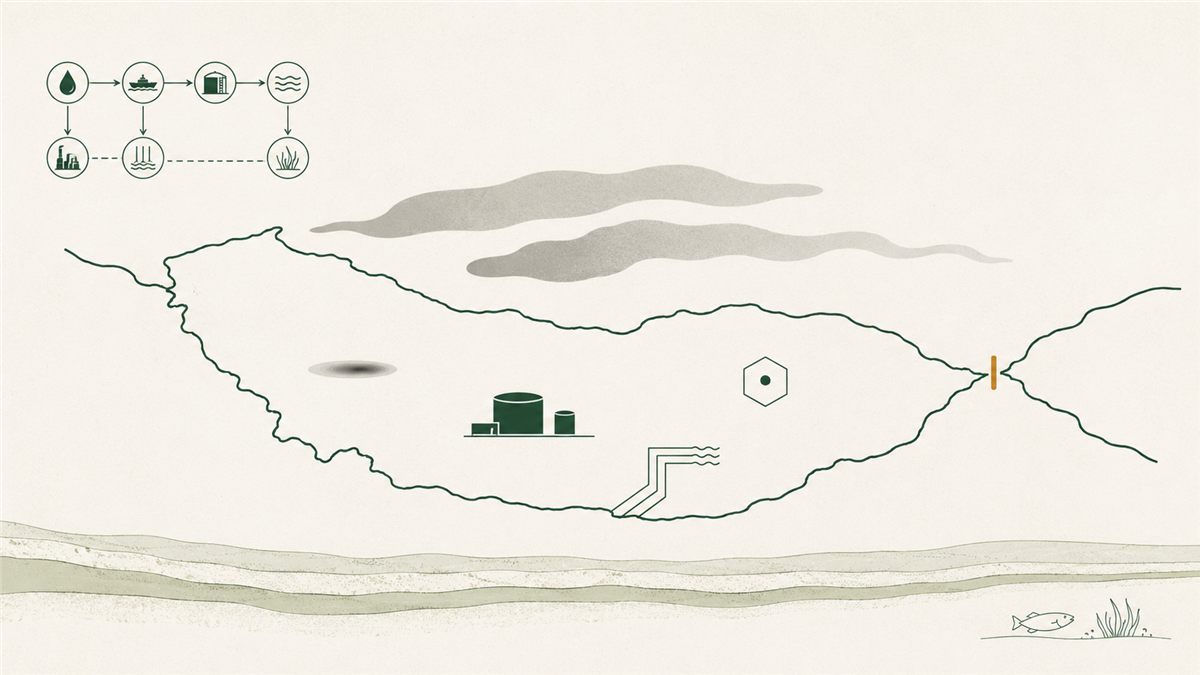
The key point is discipline. Not every feared scenario has occurred, and some public claims about nuclear fallout or irreversible Gulf-wide collapse run ahead of the evidence. But the credible risk pathways are severe enough without exaggeration: refinery fires, oil spills, tanker attacks, damage to petrochemical sites, disruption of desalination plants, toxic residues from munitions and industrial combustion, and long-lived contamination of coastal sediments.
The most likely environmental impacts are conventional but large: oil, chemicals, smoke, disrupted water systems, damaged coastal habitats, and a prolonged recovery burden. The worst-case impacts would come from attacks on operating nuclear reactors or cascading failures across Gulf energy and desalination infrastructure.
What happened, and what is confirmed
In June 2025, conflict involving Iran, Israel, and the United States escalated to include U.S. strikes on Iranian nuclear sites. The Congressional Research Service described the episode as raising the possibility of shipping disruption through the Strait of Hormuz, the narrow waterway between Iran and Oman through which roughly 27% of global maritime crude oil and petroleum product trade and 22% of global LNG trade passed at the time.
The International Atomic Energy Agency confirmed that Fordow, Natanz, and Esfahan had been hit following U.S. aerial attacks on 22 June 2025. The IAEA also reported that Iranian regulatory authorities had not recorded an increase in off-site radiation levels after those attacks. Earlier, the IAEA had identified both radiological and chemical contamination inside Natanz, but said radioactivity outside the site remained normal.
That distinction matters. A damaged enrichment facility is not the same environmental scenario as a damaged operating reactor. Uranium enrichment sites can create serious on-site chemical and inhalation hazards, especially from uranium compounds and hydrogen fluoride. They are not, however, large heat-generating reactor cores full of fission products. The IAEA was far more explicit about the risk from Bushehr, Iran's operating nuclear power plant, warning that a direct hit or loss of reactor power in a worst case could produce a high release of radioactivity and require protective actions over large distances.
Immediate environmental consequences
The first environmental phase of a U.S.-Iran war would be acute and uneven: visible smoke plumes in some locations, hidden chemical contamination in others, and rapid pressure on coastal services. The biggest immediate risks fall into five categories.
| Impact pathway | Immediate consequence | Why it matters |
|---|---|---|
| Oil and tanker spills | Crude, fuel oil, or refined product releases from terminals, vessels, storage tanks, pipelines, or refineries. | Oil can smother mangroves, mudflats, salt marshes, seagrass beds, and coastal bird habitat while contaminating sediments for years. |
| Industrial fires | Smoke, soot, volatile organic compounds, PAHs, sulfur oxides, nitrogen oxides, metals, and firefighting runoff. | Air pollution affects nearby communities immediately and deposits contaminants onto land and water. |
| Petrochemical releases | Damage to refineries, chemical plants, fuel depots, fertilizer facilities, or storage yards. | These sites can release toxic substances that are not captured by carbon metrics but dominate local health and ecological risk. |
| Desalination disruption | Oil or chemical contamination at seawater intakes, direct infrastructure damage, or power interruptions. | Many Gulf states rely on desalination for drinking water, so marine pollution can quickly become a water-security crisis. |
| Military debris | Unexploded ordnance, metals, propellants, burned vehicles, damaged ships, and contaminated rubble. | Cleanup is dangerous, slow, and often underfunded after the fighting stops. |
The June 2025 energy-market context shows why the environmental stakes are so high. The Strait of Hormuz is not just a route on a map; it is a compressed corridor for oil, LNG, shipping, ports, and military forces. CRS noted that disruption could include kinetic attacks on oil production, storage, refining, pipeline, and export infrastructure, targeted attacks on tankers, or attempts to halt transit through the Strait.
Each of those scenarios has an environmental version. A refinery strike is also an air-quality event. A tanker attack is also a spill risk. A port closure is also a queue of vessels carrying fuel and hazardous cargo. A mine-clearing operation is also a seabed disturbance. The environmental harm is not separate from the military and economic story; it rides inside it.
Nuclear-site and chemical-contamination risks
Nuclear language can flatten important differences. The confirmed June 2025 concern at Natanz was not an off-site radiological release affecting the public. The IAEA reported normal off-site radioactivity, while warning of contamination inside the facility and chemical toxicity risks. The likely hazard profile at an enrichment site is dominated by uranium compounds, hydrogen fluoride, damaged centrifuge systems, contaminated dust, and worker exposure during emergency access and cleanup.
That is still serious. Alpha-emitting uranium particles are especially dangerous if inhaled or ingested, and hydrogen fluoride is highly toxic and corrosive. But it is a localized industrial and radiological-safety problem, not the same thing as a reactor accident.
Enrichment facilities create chemical and localized radiological hazards. Operating reactors create a different worst-case risk because they contain large inventories of radioactive fission products and require cooling. The IAEA singled out Bushehr as the site where consequences of an attack could be most serious.
The long-term nuclear-adjacent risk is therefore not only radiation. It is loss of monitoring, restricted inspector access, damaged safety systems, contaminated buildings that cannot be safely entered, and degraded trust around nuclear material inventories. Environmental response depends on access, measurement, and chain-of-custody. War damages all three.
Why the Persian Gulf is unusually vulnerable
The Persian Gulf is a hard place for pollution to disappear. A 2026 Ambio article described it as ecologically fragile, shallow, semi-enclosed, hot, saline, and heavily dependent on seawater infrastructure. Exchange with the open ocean is restricted through the Strait of Hormuz, which means pollutants can persist in sediments and coastal habitats rather than rapidly dispersing.
The Gulf also contains habitats that are both biologically important and physically exposed: coral reefs, seagrass beds, mangroves, salt marshes, mudflats, and soft-sediment communities. These support fisheries, stabilize shorelines, and provide nursery grounds for fish and invertebrates. They are already stressed by heat, salinity, hypoxia, dredging, coastal development, and industrial activity. Conflict adds an acute shock to a system with limited spare capacity.
Historical analogues are sobering. During the 1991 Gulf War, researchers estimated that about 7 million barrels of crude oil were intentionally released into the Gulf, with up to 1.9 million barrels of hydrocarbons contaminating intertidal habitats along roughly 700 km of coastline from Kuwait into Saudi Arabia and as far as Qatar. Later surveys found buried oil and tar mats persisting for decades, with the slowest recovery expected in low-energy habitats such as salt marshes.
That does not mean a U.S.-Iran war would mechanically repeat 1991. The facilities, actors, technologies, and response capacity are different. But the physical setting is the same basic trap: concentrated hydrocarbons and chemicals beside a shallow sea with slow flushing and enormous dependence on coastal infrastructure.
Long-term consequences
The long-term environmental consequences would depend on duration, targets, weather, response access, and whether escalation reaches oil export infrastructure, refineries, petrochemical plants, or operating reactors. The most plausible long-run harms are cumulative rather than cinematic.
Chronic sediment contamination
Oil, heavy metals, and combustion byproducts can settle into sediments, especially in low-energy coastal zones. Once buried, they may re-emerge during storms, dredging, construction, or future spills. This creates a long tail of ecological exposure even after surface slicks are cleaned.
Fisheries and food-web effects
Mangroves, mudflats, seagrasses, and salt marshes are nursery habitat. Damage there can reduce recruitment of fish and invertebrates, with effects moving through local food webs and coastal economies. Fishery losses may outlast the fighting because biological recovery depends on habitat recovery, not only cleanup.
Air-quality and public-health burdens
Oil and industrial fires produce particulate matter, PAHs, volatile organic compounds, sulfur oxides, nitrogen oxides, and metals. The U.S. Institute of Medicine's review of Persian Gulf War health consequences noted the difficulty of reconstructing individual exposure to oil-well fires and related pollutants after the fact. That is a recurring lesson: if monitoring is not ready when the smoke starts, the health evidence becomes permanently incomplete.
Water-security fragility
Desalination is a defining vulnerability. Oil slicks and chemical contamination can force intake shutdowns; power disruptions can stop plants; damaged treatment systems can release process chemicals. In a prolonged conflict, environmental damage could therefore convert into a drinking-water and electricity reliability problem.
Delayed reconstruction and sanctions effects
Environmental cleanup requires equipment, spare parts, specialist contractors, financing, insurance, sampling access, and transparent institutions. Sanctions, insecurity, and damaged ports can slow all of that. The result is a familiar conflict pattern: contamination is created quickly and remediated slowly.
Carbon accounting and disclosure implications
For carbon accounting practitioners, the direct emissions of war are only part of the inventory problem. Military fuel combustion, emergency flaring, refinery fires, backup diesel generation, rerouted shipping, replacement production, reconstruction materials, and supply-chain disruption all create emissions that may appear across Scope 1, Scope 2, and Scope 3 depending on the reporting entity.
There are three practical implications.
- Use event-specific assumptions. Do not rely on ordinary-year emission factors for extraordinary rerouting, emergency generation, damaged infrastructure, or conflict-driven procurement changes.
- Separate GHG impacts from toxic impacts. A low-carbon number does not mean low environmental harm. Chemical releases, oil contamination, and water-system failures need separate disclosure and risk treatment.
- Document boundary decisions. War-related disruption can shift emissions between suppliers, regions, transport modes, and inventory years. Auditable notes matter.
The larger climate consequence is also indirect: conflict around the Strait of Hormuz can change global energy behavior. Price shocks may suppress demand in some places, increase coal or fuel-oil substitution in others, trigger strategic stock releases, or accelerate energy-security investments. The net emissions effect is therefore not obvious without scenario modelling.
What to watch next
The environmental severity of any renewed U.S.-Iran escalation would be shaped less by rhetoric than by a few concrete indicators: attacks on refineries and export terminals, confirmed spills, damage to desalination plants or power systems, shipping restrictions in the Strait of Hormuz, loss of IAEA access, signs of damage at Bushehr or Tehran's research reactor, and whether regional monitoring data remain publicly available.
The practical lesson is unglamorous but important. Environmental preparedness in the Gulf should not wait for the first major spill or plume. Remote sensing, shared pollution baselines, emergency water planning, port contingency plans, transparent radiation monitoring, and post-strike industrial sampling are not soft add-ons to security policy. They are the infrastructure that determines whether wartime environmental damage becomes a short emergency or a decades-long liability.
Frequently asked questions
Would bombing Iranian nuclear facilities create a Chernobyl-style disaster?
Not for enrichment facilities such as Natanz or Fordow. The IAEA reported chemical and localized radiological contamination inside Natanz in June 2025, but no increase in off-site radiation levels. The larger radiological danger would come from an attack on an operating reactor such as Bushehr, which the IAEA warned could cause a high release of radioactivity in worst-case scenarios.
What is the largest immediate environmental risk from a U.S.-Iran war?
The largest immediate risk is not a single battlefield emission source. It is cascading damage to oil, gas, shipping, refinery, petrochemical, power, and desalination infrastructure around the Persian Gulf, especially if attacks or accidents trigger oil spills, fires, chemical releases, or disruption of seawater-dependent systems.
Why is the Persian Gulf especially vulnerable?
The Persian Gulf is shallow, semi-enclosed, hot, saline, and connected to the open ocean mainly through the Strait of Hormuz. Pollutants can persist in sediments and coastal habitats, while many Gulf states rely heavily on desalination and coastal industrial infrastructure that can be disrupted by oil or chemical contamination.
- U.S. Energy Information Administration, "Amid regional conflict, the Strait of Hormuz remains critical oil chokepoint", 16 June 2025.
- Congressional Research Service, "Iran Conflict and the Strait of Hormuz: Oil and Gas Market Impacts", 2025.
- International Atomic Energy Agency, Director General Grossi statement to the UN Security Council, 20 June 2025.
- International Atomic Energy Agency, "Update on Developments in Iran (5)", 22 June 2025.
- Samimi-Namin et al., Ambio, "Marine environmental risks from armed conflict in the Persian Gulf: Past warnings, present urgency", 2026.
- Institute of Medicine / NCBI Bookshelf, "Health Consequences of Service During the Persian Gulf War", environmental exposure background.
- Associated Press, reporting on a Persian Gulf island oil spill during the Iran war, May 2026.