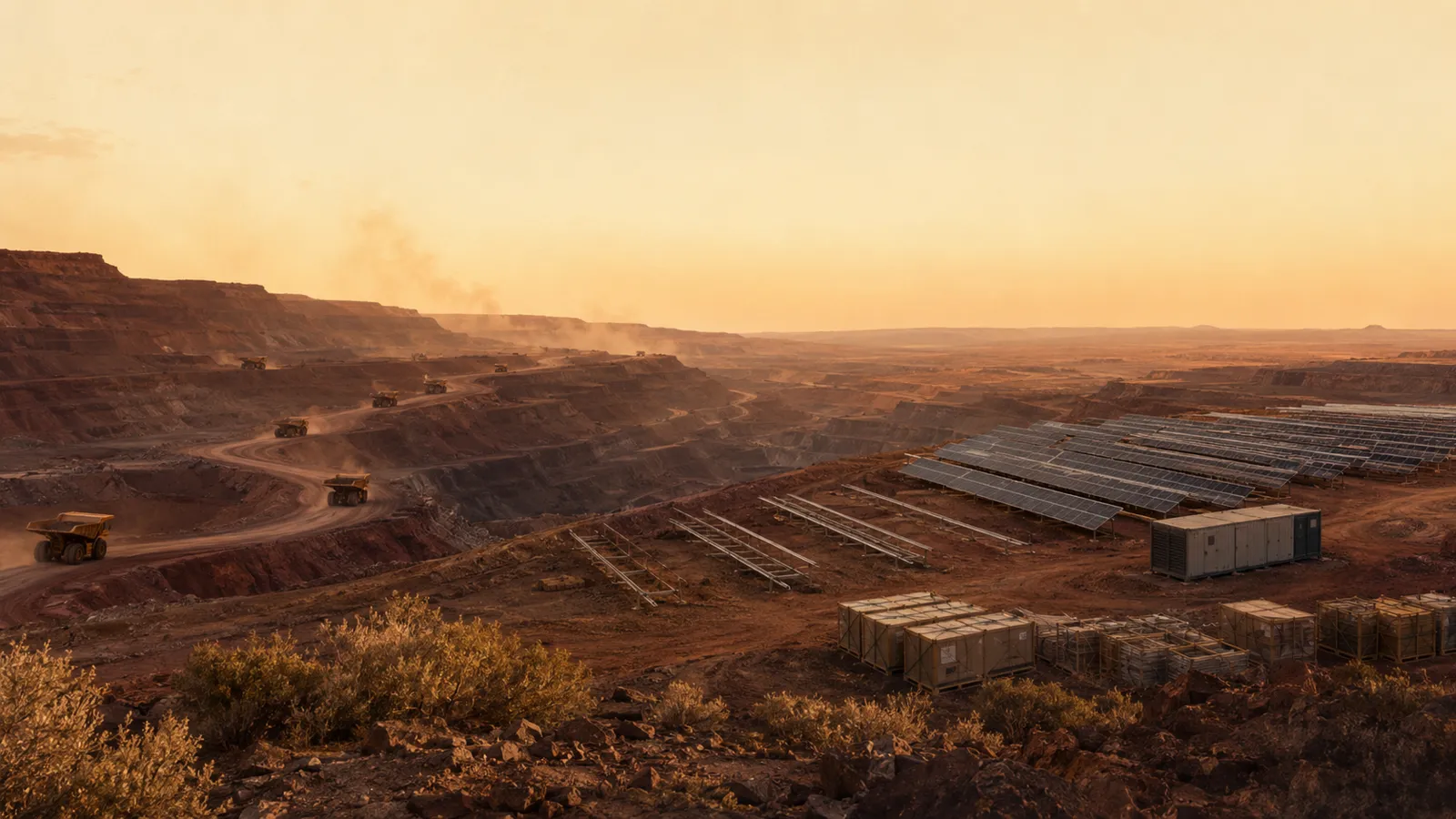
The world's biggest miner is facing its most serious climate credibility test in years after leaked internal documents — dubbed the "BHP files" — revealed that the company has halted or delayed projects to cut emissions across its Western Australian iron ore business, and war-gamed options to push major climate investments in the Pilbara into the next two decades.
The records, reported jointly by The Guardian and ABC's Four Corners in late May 2026, show BHP was internally aware that delayed action in the Pilbara would pose a "reputational risk" and that "urgent decarbonisation in line with BHP's public commitments" was effectively tied to its "licence to operate". The gap between that internal framing and the company's external narrative is what is now drawing scrutiny from investors, regulators and civil society.
Several specific projects sit at the centre of the reporting. A 50-megawatt solar farm and 20MW battery at the Jimblebar mine — approved and funded by the board in mid-2023 — was effectively shelved shortly afterwards. An iron ore processing plant described internally as "well-aligned" with BHP's climate transition action plan, and capable of avoiding around 1.7 million tonnes of emissions a year, was quietly dropped. And despite plans to begin replacing diesel haul trucks with electric vehicles from 2027–28, the company has continued to acquire diesel trucks for long-term service, including a reported purchase of more than A$500 million in new diesel haulers at Jimblebar.
The disclosure stakes are high. BHP is one of the largest reporters under Australia's National Greenhouse and Energy Reporting (NGER) scheme and now falls within the scope of the country's mandatory climate-related financial disclosures regime. Group 1 reporters are required to describe their climate-related transition plans, the resilience of their strategy under different scenarios, and any material assumptions behind their targets. Documents that appear to show a planned divergence between internal capital allocation and stated decarbonisation pathways are precisely the kind of evidence that disclosure regulators, auditors and litigators are now trained to look for.
The episode also reinforces a broader pattern visible in recent enforcement and litigation activity: a hardening evidentiary bar for corporate climate claims. As we noted in coverage of the Apple carbon-neutral litigation and climate litigation risk in Australia, claims that look defensible at the marketing layer can unravel quickly when internal records show a different operational reality. For high-emitting sectors, alignment between public transition plans, internal capital decisions, and reported Scope 1 and Scope 2 emissions is no longer just a sustainability-comms question — it is a disclosure-grade legal and financial risk.
For practitioners working on corporate inventories, transition planning or assurance, the BHP files are a useful reminder of where the pressure now sits. Decarbonisation roadmaps need to be reconcilable with capex decisions, fleet procurement, and the emissions trajectory implied by reported activity data. Where they are not, the gap is increasingly likely to be surfaced — through leaks, litigation, or regulator-led reviews of disclosures under regimes such as AASB S2 in Australia and equivalent standards globally. See our guide to greenwashing risk in carbon accounting for more on how to test transition claims against the underlying data.
← Back to News